Invisible Ranks
And The Insatiable Thirst for More

Recently, I went to Philadelphia for the weekend to visit one of my best friends from college. While we caught up on each other's lives, one conversation stood out. I was regaling my friend with all the ways I felt inadequate – I wasn’t working hard enough, being a good enough friend, making enough money, gaining enough followers, etc. As I finished speaking, she said, ‘I need to point out how many times you said “not enough” during this conversation.’”
“Oh my god, you’re right,” was all I could muster.
I’ve worked with a life coach, have dear friends, and have written on the subject of shame. Even with all of that, I still fall prey to the collective delusion that being “enough” is about external factors like money, power, or fame. While it’s easy to dismiss these feelings as personal flaws, the truth is that they are part of a much larger societal delusion—one that even the wealthiest and most powerful individuals cannot escape. Capitalism has created a world where worth is measured by material success, power, and status. From social media to the corporate world, these external markers are presented as the ultimate goal, fostering the belief that we can never be enough unless we meet these standards.
I was grateful at that moment to have a friend who could point this out and remind me of the “enoughness” inside us all. There is no inherent hierarchy to humanity. A person’s external reality says nothing about their happiness, generosity, or moral compass. Elon Musk is a great example of this. Worth $300 billion, and now a “special government employee,” there exists a gaping hole inside him that he cannot fill. Regardless of how much money or power he gains, the hole remains empty.
It can seem confusing. Why would somebody with “everything” still feel unsatisfied? This clip, taken from the My First Million podcast adds some interesting context. In the episode, Scott Galloway, worth $100 million, and Sam Parr, worth $20 million discuss their financial anxieties.
Galloway: “I’m still very anxious about money…I still feel financially very insecure. I’m still trying to make a shitton of money. I still worry about a recession becoming a depression and I'm the guy who lost it again…I don’t feel I’m at that point where I don’t have financial anxiety. I do sleep with one eye open.”
Parr echoed some of these sentiments saying, “I still feel shitty…I’m broken. It doesn’t matter how much therapy I go to. When it comes to money I have a scarcity mindset.” To which Galloway replied, “Yeah, I’m the same way.”
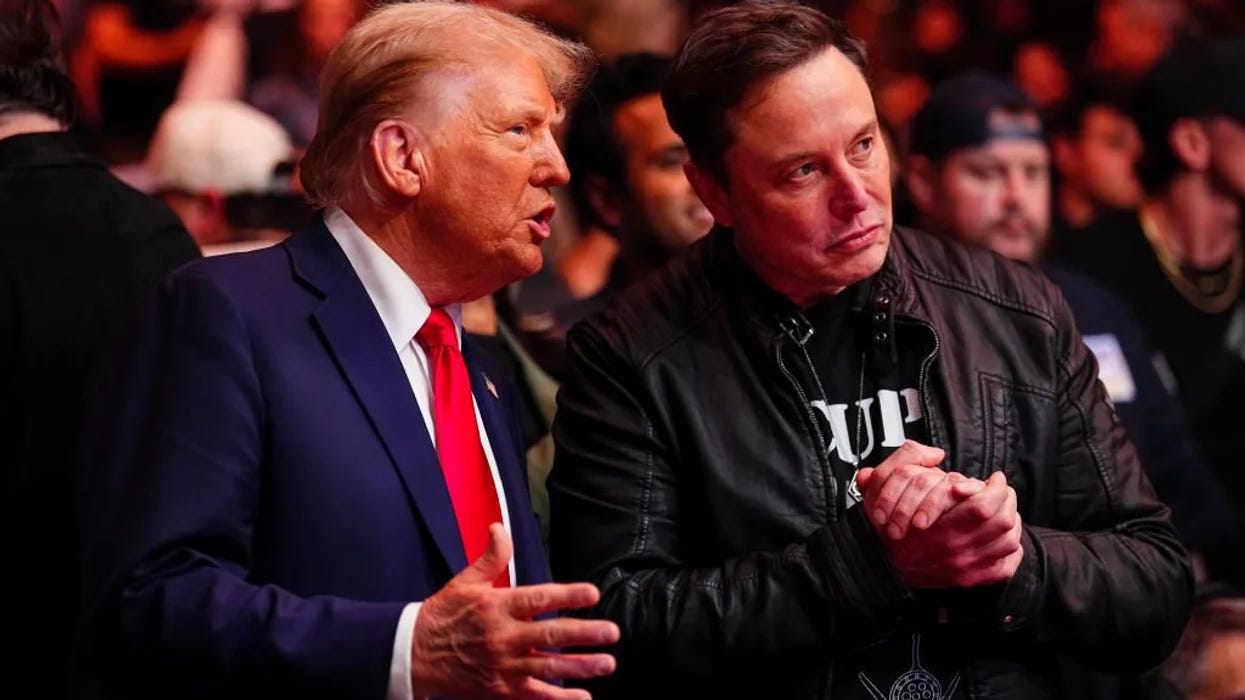
It’s clear to see this lack mentality at play in our current political landscape. Elon Musk and Donald Trump are addicted to adoration and obsessed with legacy. But no amount of praise will ever be enough. The way they operate isn’t from a genuine yearning to help people — it is from an egoic desire to be celebrated as great leaders who changed the course of time.
Perhaps Musk started off as a person who genuinely cared about taking action towards climate change, but that is no longer at the top of his priority list. Unchecked power appears to be more important to him nowadays. I suspect Trump is similar. He didn’t enter politics until he was 54 years old. Prior to then, he seemed relatively content to be a celebrity businessman. Once his former goals weren’t cutting it though, he moved onto new ambitions. Now president for a second term, that will not be enough for him either. It’s impossible to know what his true motivations are, as they appear to change moment to moment, but figuring out how to make his constituents' lives better doesn’t appear to be one of them.
In order for fascism to thrive, leaders must surround themselves with yes-men who will not question their authority. In this structure, they possess no authentic connections. Maslow’s Hierarchy of Needs suggests that once our basic physiological and safety needs are met, we seek fulfillment in self-esteem and self-actualization. However, when individuals bypass the third level—connection and community—in pursuit of these higher needs, they are left feeling isolated and unfulfilled. Because there is a profound loneliness where there is no connection, their hunger for more only continues.
While it’s easy to criticize these figures, their feelings of inadequacy stem from a broader societal narrative that constantly reinforces the notion that one’s worth is tied to external success. There is a mistaken idea that if we have more, we will be more. The truth is that we are whole just as we are.
Desire is not a reliable emotion. Left unchecked, it becomes an insatiable force that harms not only the individuals consumed by it, but also broader society. Regardless of what they gain, the hyper-rich and powerful may never feel satisfied. In the process, their endless pursuit of more perpetuates a toxic culture of competition, division, and exploitation.
One of the reasons I write so passionately on the subject of love — loving ourselves, humanity, and the Earth — is because I’m unbelievably tired of living inside the harmful collective insanity that has convinced so many of us that we will never be enough.
Many of the social ills of our world stem from putting ourselves inside invisible ranks. The false belief that some lives are more valuable than others only deepens the idea that we must climb a social ladder to be considered worthy. This invisible hierarchy not only divides us but also justifies forms of oppression, such as racism, classism, and ableism. By internalizing the idea that some lives are more valuable than others, we perpetuate systems that leave marginalized groups disenfranchised.
While the hierarchy of humanity is a construct, its effects on our lives and on society are profoundly real. But the reason so many of us subscribe to it, even unconsciously, is because the hierarchy promises that, as long as we’re not at the bottom, we’ll be okay. But this could not be further from the truth. We all exist in relation to one another, and we need each other to survive.
For those at the top of the illusive hierarchy, it is very convenient for them if everyone else believes in it too. That way, we will always believe that we lack power and that it is fruitless to dream and work towards a New Earth.
Only in community can we build a world that values the lives of all who inhabit it. If there is one thing you take away from this piece, let it be that you are whole and have always been enough. We are not defined by what we do or how much we accumulate, but by who we are. You do not need to prove yourself to anyone or convince the world of your value. You are valuable simply because you exist. As much as the world may try, nobody can ever take that away from you.
Interesting thoughts… at this stage in history there were serious experiments and attemps to create more just societies where to focus was the individual, happiness and less the material possessions.. even the beginnings of the great revolutions were very idealistic
However none prospered in the long run
Perhaps that tells something about the human condition and why humans in societies are inherently competitive
I agree we should value our selves for the persons we are.. at the same time people want to differentiated and show anything they can accomplish. For the majority, lacking very unique talents, money success became that vehicle